SEAMEO BIOTROP Strengthens GEMS Implementation in Ciletuh UNESCO Global Geopark through Local Potential-Based Learning
Sukabumi, Indonesia, 11 August 2026 — SEAMEO BIOTROP is strengthening the implementation of the Geopark Educational Model for Schools (GEMS) through the National Training titled “Geoparks as Living Laboratories: Integrating Biodiversity Education, Agrobiodiversity, and Sustainable Community Development in Southeast Asia,” held on 11–13 August 2026 at SMA Negeri 1 Cikakak, Sukabumi Regency, West Java. The activity was attended by 33 high school and vocational high school (SMA/SMK) teachers around the Ciletuh area and aimed to develop geoparks as living laboratories to support learning based on biodiversity, agrobiodiversity, and local potential.
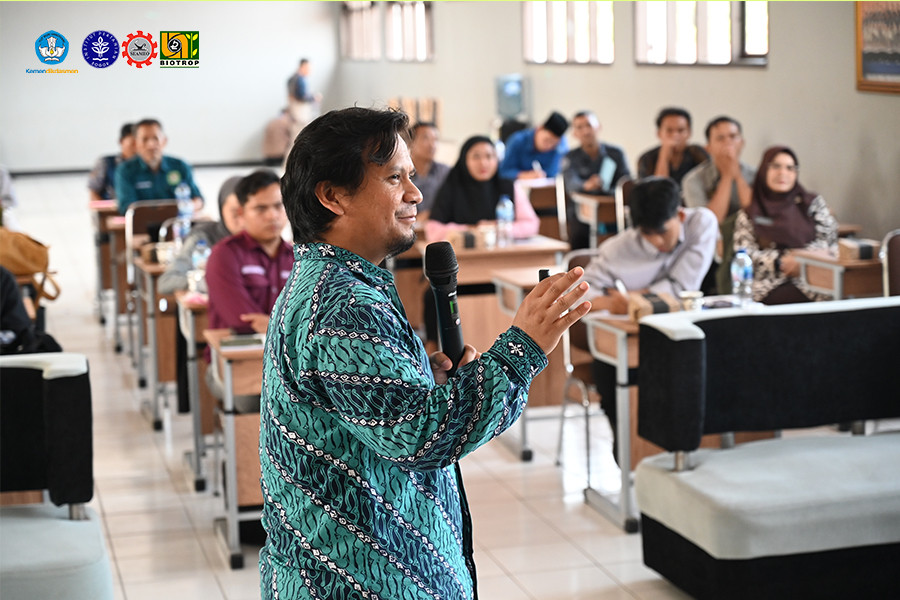
The training was officially opened on Tuesday (11 August) at SMA Negeri 1 Cikakak by Deputy Director for Program of SEAMEO BIOTROP, Doni Yusri. The opening ceremony was also attended by a representative of the Head of the Regional Office of the West Java Provincial Education Office for Sukabumi Regency, the Principal of SMA Negeri 1 Cikakak, and the training participants.
Deputy Director for Program, Doni Yusri, emphasized the importance of incorporating the environment surrounding schools into the learning process. According to him, GEMS encourages schools to utilize the geological, biodiversity, agricultural, and cultural richness of geopark areas as contextual and applicable learning resources.
“Through GEMS, we aim to encourage schools to view the potential of their surrounding environment as part of the learning process. Ciletuh has rich geological, biodiversity, agricultural, and cultural resources that can be translated into contextual and applicable learning experiences,” said Doni.
Principal of SMA Negeri 1 Cikakak, Jaka Suryawan, stated that the activity serves as an opportunity to strengthen participants’ competencies, particularly in developing agrobiodiversity-based learning. He highlighted the importance of a practice-based approach in providing more meaningful learning experiences while ensuring that the knowledge gained can provide practical benefits in everyday life.
Representing the Head of Regional Education Office V, Iwan Setiawan expressed support for efforts to preserve the geopark. According to him, a geopark is not only a geological heritage site but can also serve as a living laboratory that connects biodiversity, agrobiodiversity, and community life within an integrated learning ecosystem. He expressed hope that the utilization of geoparks as learning spaces can continue to be developed to support the preservation of the area.
Programme Coordinator, Dewi Suryani, explained that the GEMS training in Ciletuh was designed to help participants translate the potential of the geopark into learning resources that can be adapted to the characteristics of their respective schools and regions. Through a combination of classroom learning and field experiences, participants are expected to develop more applicable learning approaches based on local potential.
Throughout the three-day training, participants engaged in learning activities combining conceptual sessions, discussions, practical activities, and field visits. The topics covered included an introduction to Ciletuh Sukabumi Geopark as a learning space; identification and planning of Ciletuh-specific commodities; cultivation techniques for local vegetables, medicinal plants, and fruit crops; as well as vegetation analysis, weed identification, and the identification of Invasive Alien Species (IAS). Participants also learned about educational land mapping using basic Geographic Information System (GIS) techniques and conducted various practical activities related to the topics presented.
The learning activities were complemented by field visits to SMP Negeri 1 Cisolok and Pondok Pesantren Al-Umanaa. Participants conducted observations, discussions, and question-and-answer sessions to directly explore the utilization of geopark potential and the development of educational land in different educational settings.
“GEMS is designed to enable geoparks to be meaningfully utilized in the educational process. Through the activities in Ciletuh, participants learn to identify biodiversity and agrobiodiversity potential, develop educational land, and connect these resources with the learning needs of schools,” explained Dewi.
The implementation of GEMS in Ciletuh also strengthens collaboration among SEAMEO BIOTROP, educational institutions, local government, and stakeholders in the geopark area. Such collaboration is expected to ensure that the utilization of geoparks as learning spaces continues to develop into sustainable educational practices.
As the second GEMS training following its implementation in Rinjani-Lombok UNESCO Global Geopark, the Ciletuh training is expected to contribute to the further development and refinement of the GEMS model for replication in other geoparks. By utilizing biodiversity, agrobiodiversity, geodiversity, culture, and local knowledge as learning resources, GEMS is expected to strengthen the role of geoparks as living laboratories while supporting environmental education and sustainable community development.
MDM, DS, HCN