SEAMEO BIOTROP Launches GEMS to Strengthen the Role of Geoparks as Living Laboratories for Education in Southeast Asia
Lombok, Indonesia, 28 July 2026 — SEAMEO BIOTROP organized the Regional Webinar and National Training entitled “Geoparks as Living Laboratories: Integrating Biodiversity Education, Agrobiodiversity, and Sustainable Community Development in Southeast Asia” at the Rinjani-Lombok UNESCO Global Geopark from 28–31 July 2026. The event marked the inaugural implementation of the Geopark Educational Model for Schools (GEMS), an initiative launched by SEAMEO BIOTROP in 2026 to promote geoparks as living laboratories that support contextual learning based on biodiversity, agrobiodiversity, local culture, and sustainable community development.
The Regional Webinar, held on 28 July 2026, was attended by 82 participants from Indonesia, Malaysia, and the Philippines, representing educators, academics, students, geopark managers, educational institutions, and partner organizations through both onsite and online participation. The program continued with the National Training from 29–31 July 2026, involving 44 participants from various schools and educational institutions in the Rinjani-Lombok area to strengthen their capacity in developing learning models based on local potential.
In his opening remarks, Dr. Edi Santosa, Director of SEAMEO BIOTROP, emphasized that the event marked an important milestone in the development of GEMS as an educational model connecting schools with the richness of biodiversity, agrobiodiversity, geodiversity, culture, and local knowledge.
He explained that the Rinjani-Lombok UNESCO Global Geopark was selected as the first implementation site because it represents the close relationship among landscapes, biodiversity, agriculture, culture, and local communities. Through GEMS, students are expected not only to learn inside classrooms but also to gain firsthand learning experiences through field observations, practical activities, and interactions with their surrounding environment. In this way, geoparks can function as living laboratories that integrate science, education, conservation, and sustainable development.
Wirman, Head of the Center for Teachers and Education Personnel (BGTK) of West Nusa Tenggara Province, expressed his appreciation to SEAMEO BIOTROP for initiating the program and to all parties supporting its implementation. According to him, GEMS provides a relevant educational approach by encouraging teachers and education personnel to utilize the environment as a learning resource while fostering students' environmental awareness and stewardship.
He further noted that the GEMS approach aligns with Indonesia's national education direction, which promotes contextual learning and the integration of science, the environment, and culture. He expressed his hope that the outcomes of the training would soon be implemented in schools, particularly those located within and around the Rinjani-Lombok UNESCO Global Geopark.
Dr. Doni Yusri, Deputy Director for Program of SEAMEO BIOTROP, explained that GEMS was developed to bridge the rich potential of geoparks with formal learning processes in schools. Geodiversity, biodiversity, agrobiodiversity, culture, and local knowledge can all serve as meaningful learning resources when translated into structured, contextual, and practical educational activities.
“Through GEMS, we aim to encourage schools to view geoparks as authentic learning spaces. Students can learn directly from landscapes, biodiversity, agriculture, culture, and the surrounding communities. Rinjani-Lombok serves as the first step in exploring how this approach can be implemented and further developed in collaboration with schools and stakeholders before being replicated in other geoparks according to their unique characteristics,” said Dr. Doni.
Support for the implementation of GEMS was also expressed by Supriyadi, Head of the Regional Office of the Education and Culture Agency (Cabdisdikbud) Region II of East Lombok. He stated that schools' participation in GEMS presents an opportunity to develop more contextual learning by utilizing the natural resources, biodiversity, agriculture, culture, and community life of East Lombok as educational resources.
He added that sustainability should remain a key focus after the completion of the training. Collaboration among schools, local governments, geopark management authorities, SEAMEO BIOTROP, and other stakeholders is expected to further expand the utilization of the Rinjani-Lombok UNESCO Global Geopark as a learning environment while strengthening young people's awareness of environmental conservation and regional potential.
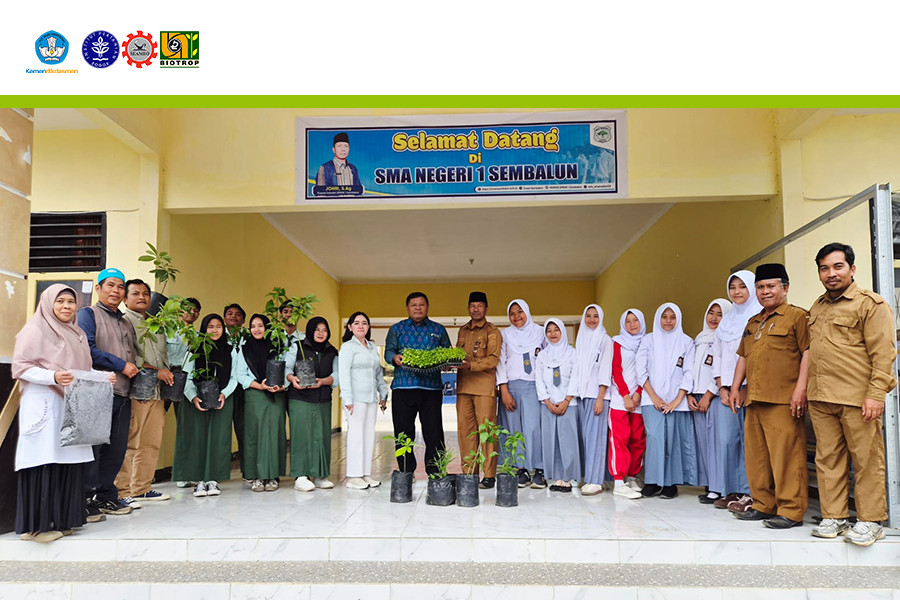
Meanwhile, Johri Albana, Principal of SMAN 1 Sembalun, stated that GEMS provides schools with an opportunity to utilize the surrounding environment as an integral part of the learning process. Located within the Rinjani-Lombok UNESCO Global Geopark, SMAN 1 Sembalun has significant potential to integrate landscapes, biodiversity, agriculture, culture, and community life into students' learning experiences.
“For us, the Sembalun environment is not only where we live and study but also a remarkably rich learning resource. Through GEMS, teachers and students are encouraged to recognize the potential surrounding the school as part of the learning process. We hope this initiative will inspire learning that is closely connected with nature and community life while fostering a sense of ownership and responsibility among the younger generation to preserve the Rinjani-Lombok UNESCO Global Geopark,” he said.
Sugiarta, Principal of SMKN PP Mataram, also emphasized that GEMS is highly relevant to vocational education because it enables students to connect the competencies learned in school with real-world conditions. For agricultural vocational schools, the agrobiodiversity and agricultural practices within the geopark offer valuable learning resources while helping students understand the importance of sustainable natural resource management.
“As an agricultural vocational school, we believe GEMS can strengthen practice-based learning. Students not only learn about cultivation and agricultural production but also understand that agriculture is closely interconnected with biodiversity, environmental conditions, culture, and community life,” he concluded.
Ms. Dewi Suryani, Programme Coordinator, explained that this event was the first Regional Webinar and National Training conducted under the GEMS program, specifically designed to strengthen the use of geoparks as contextual learning environments. The Regional Webinar presented diverse perspectives on the role of geoparks in biodiversity education and sustainable development, while the National Training combined classroom learning, interactive discussions, hands-on practice, action plan development, and field-based learning activities at the Rinjani-Lombok UNESCO Global Geopark, SMKN PP Mataram, and SMAN 1 Sembalun.
Throughout the four-day program, participants engaged in various lectures and practical sessions covering vegetation analysis, identification of weeds and invasive alien species, medicinal plant cultivation, highland horticulture, local fruit commodities, basic GIS mapping, field observation, and the preparation of action plans for GEMS implementation. The program was designed to bridge scientific concepts with field practice, enabling participants to gain practical learning experiences that can be adapted and replicated according to the characteristics of geoparks and schools in their respective regions.
The experience gained from the first implementation of GEMS at the Rinjani-Lombok UNESCO Global Geopark is expected to serve as the foundation for expanding and replicating the program in other geoparks across Indonesia and Southeast Asia. Through this initiative, geoparks are expected to play an increasingly significant role as living laboratories that strengthen biodiversity education, environmental conservation, the utilization of local potential, and sustainable community development.
MDM, DS, HCN