Strengthening Sustainable Education, SEAMEO BIOTROP Launches Circular Economy Program
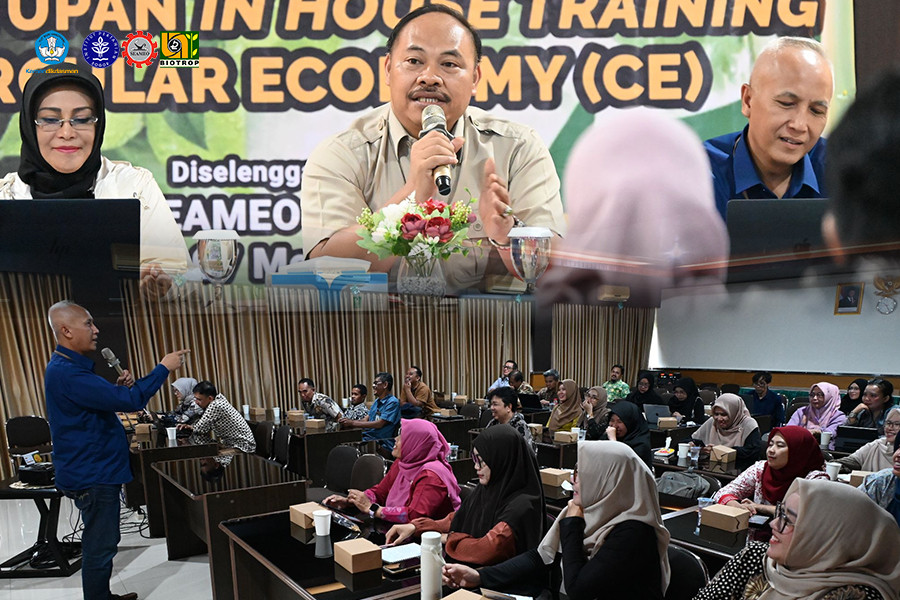
Bogor, 7 May 2026 – SEAMEO BIOTROP organized the Launching Program and Closing Ceremony of the In-House Training (IHT) on Circular Economy (CE), held in a hybrid format at the Matoa Room and via Zoom. The activity was attended by teachers from various schools across Indonesia, both onsite and online, from different regions.
The event was part of SEAMEO BIOTROP’s efforts to strengthen educators’ understanding and capacity in implementing circular economy concepts within educational environments. In addition to marking the conclusion of the training series, the activity also served as the launch of a follow-up program expected to be expanded through national training programs, national seminars, and regional forums related to circular economy initiatives.
In his opening remarks, Director of SEAMEO BIOTROP, Edi Santosa, emphasized that current environmental and resource management challenges require a shift in public mindset, particularly in the way people perceive products and waste.
“The Earth is not increasing in size, yet our desires continue to grow without limits. Therefore, the concept of circular economy is not merely about recycling waste, but about how we think about a product from the very beginning,” he stated.
He further explained that within the circular economy concept, products that are no longer used can still be transformed into other valuable products with new functions and benefits. According to him, this mindset should be introduced early through education to build awareness and a culture of sustainability within society.
Moreover, he expressed hope that the program would inspire participants and encourage real action for both present and future sustainability efforts. He also emphasized that sustainability learning is part of lifelong education that should continuously be learned and practiced by everyone throughout their lives.
Meanwhile, the IHT program was designed as an initial step toward building networks and strengthening teachers’ capacities regarding circular economy implementation. The program is expected to serve as a bridge toward broader and more sustainable activities at both national and regional levels.
During the material session, participants received a presentation from Doni Yusri entitled “Building a Circular Economy-Based Business Model through Organic Waste Management in Schools.” In his presentation, he highlighted the importance of organic waste management as an opportunity to create added value while supporting the development of more sustainable school environments.
Risa Rosita, S.Si., M.Si., the training coordinator, presented a report on the Circular Economy In-House Training (IHT) held at SEAMEO BIOTROP from April 7 to May 7, 2026. This activity is part of SEAMEO BIOTROP's commitment to supporting the development of biomass-based circular economy practices and strengthening human resource capacity to address environmental challenges and sustainable development. The program launch and closing ceremony were attended by 16 internal employees, consisting of technicians and administrative staff from various work units, as well as the Education Office and schools in eight provinces: DKI Jakarta, West Java, Bangka Belitung Islands, Maluku, NTT, Riau, South Sumatra, and North Sumatra, who attended both online and offline.
Participants were divided into three main groups based on the focus of the waste processing they developed.
1. The first group studied agricultural waste, such as straw, that can be converted into bioenergy, compost, and biodegradable pots.
2. The second group studied the processing of aromatic plant waste such as citronella into bioenzymes, simple herbal products, and biomass-based bukhur.
3. The third group studied household waste processing through the cultivation of maggots or Black Soldier Fly (BSF) as an organic waste decomposer and producer of alternative protein sources, and kasgot as an organic fertilizer.
Through these activities, participants gained a practical understanding of the application of zero-waste principles, nutrient recycling, and the utilization of waste into value-added products.
Through this activity, SEAMEO BIOTROP hopes that participants will not only understand the concept of circular economy theoretically, but also be able to apply it in learning activities and environmental management practices within their respective schools.
(ms, xx)