Learning from the Land: BIOTROP Introduces Geopark Education Model Training
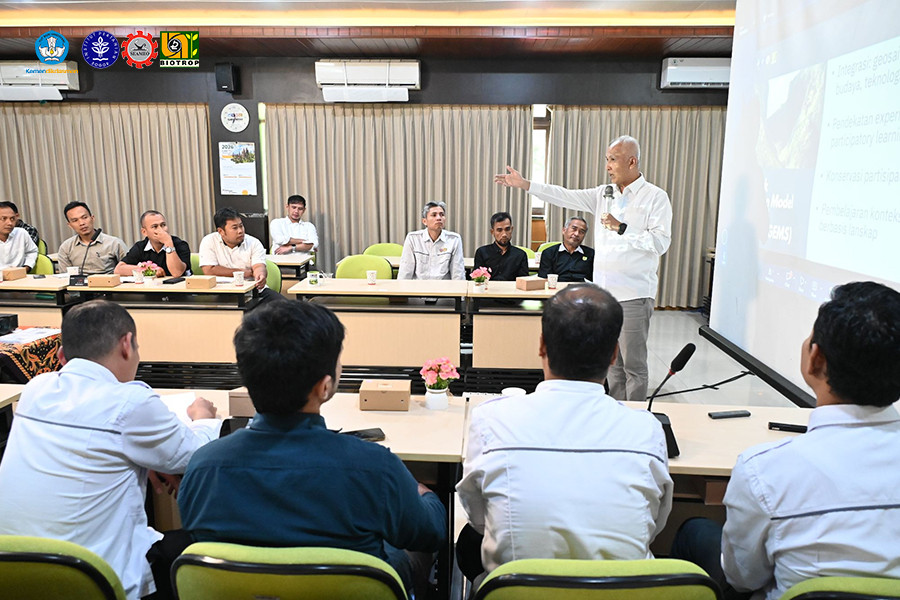
Bogor, Indonesia, 30 March 2026 — SEAMEO BIOTROP officially launched the In-House Training on the Geopark Educational Model for School Program as part of its strategic effort to strengthen biodiversity-based education and community empowerment. Conducted from 30 March to 29 April 2026, the program aims to enhance the capacity of BIOTROP staff as facilitators and trainers in developing and disseminating a geopark-based educational model centered on medicinal plants, vegetables, and fruits from upstream to downstream. The opening session was attended by the Director of SEAMEO BIOTROP, the Deputy Director for Program, expert resource persons, and internal staff.
In his remarks, Director of SEAMEO BIOTROP Dr. Edi Santosa emphasized the importance of geoparks in line with UNESCO principles, highlighting the integration of conservation, education, and sustainable development. He noted that the program not only supports educational advancement but also contributes to community empowerment and local economic development. Dr. Santosa further stressed the need to integrate conservation efforts, education, community engagement, and the management of Invasive Alien Species (IAS) within geopark areas. He encouraged SEAMEO BIOTROP to take a leading role in geopark development to foster broader stakeholder participation.
Deputy Director for Program Dr. Doni Yusri underscored that the training should generate practical and applicable outcomes beyond the institutional setting. He noted that the initiative aligns with national programs, positioning SEAMEO BIOTROP as an active contributor to geopark development efforts in Indonesia. He also highlighted the importance of program integration and the active involvement of educators to ensure meaningful impact on students.
As part of its implementation roadmap, the Geopark Educational Model (GEM) will be applied in selected priority sites, including Ciletuh Geopark (West Java), Batur Geopark (Bali), and Rinjani Geopark (West Nusa Tenggara). The program responds to government priorities through an environment and community empowerment approach, encompassing vegetation identification, spatial mapping, and integrative social capacity-building strategies.
The initiative is delivered through a series of educational workshops, training sessions, and advocacy activities, with expected outputs including capacity development, action plan formulation, and the production of publications such as news articles, policy research, and scientific papers related to GEM. The training modules cover key topics such as the conceptual framework of geopark education, identification and planning of educational commodities, cultivation techniques for medicinal, fruit, and vegetable crops, identification of invasive plants, and digital-based mapping techniques.
The program also contributes to the achievement of the Sustainable Development Goals (SDGs), particularly SDG 2 (Zero Hunger), SDG 3 (Good Health and Well-being), SDG 4 (Quality Education), SDG 13 (Climate Action), SDG 15 (Life on Land), and SDG 17 (Partnerships for the Goals).
Ms. Dewi Suryani, the Training Coordinator, in her report explained that the In-House Training aims to enhance the capacity of 22 BIOTROP staff from the Human Centre and Innovation Department (HCID) and the Science Innovation and Technology Department (SITD) as facilitators and trainers in developing and disseminating the Geopark Educational Model based on medicinal plants, vegetables, and fruits from upstream to downstream. Resource persons involved in the training include Affiliate Scientists of SEAMEO BIOTROP, namely Dr. Supriyanto on plant cultivation techniques and Dr. Soekisman Tjitrosoedirdjo on weed and Invasive Alien Species (IAS) identification, as well as vegetation analysis. Experts from IPB University also contributed, including Dr. Burhanuddin Masyud on the identification and planning of educational commodities, Mr. Sandra Arifin Azis on medicinal plant cultivation based on geopark land characteristics, Dr. Muhamad Syukur on vegetable cultivation techniques, and Dr. Setyardi on basic GIS-based educational land mapping.
Through this In-House Training, SEAMEO BIOTROP reaffirms its commitment to advancing an integrative and sustainable geopark-based educational model while strengthening the synergy between conservation, education, and community empowerment at the regional level.