Regional Seminar and Workshop Develops Roadmap for Digital Herbarium Database as an Innovative Teaching and Learning Tool
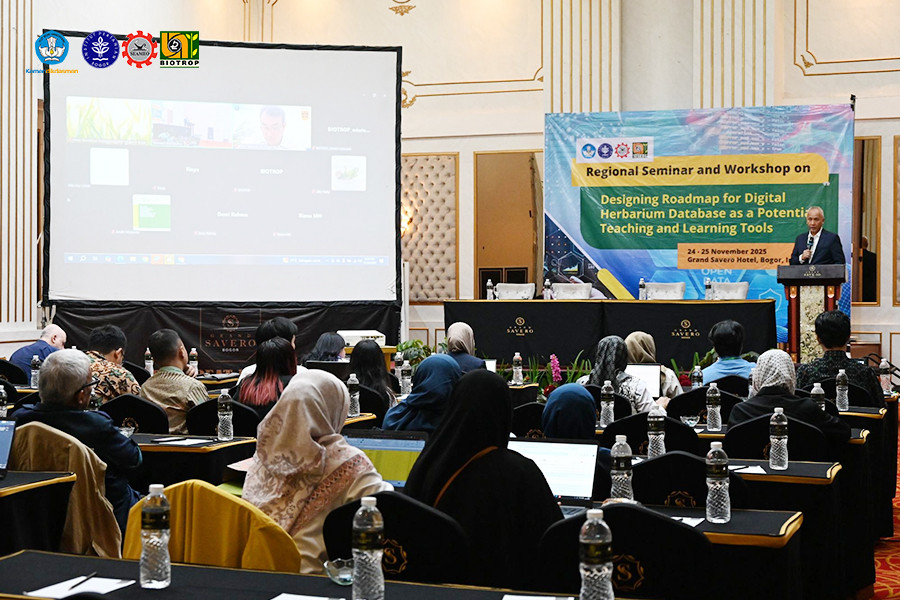
Bogor, Indonesia, 25 November 2025 — SEAMEO BIOTROP successfully organized the Regional Seminar and Workshop on Designing a Roadmap for a Digital Herbarium Database as a Potential Teaching and Learning Tool on 24–25 November 2025 at Grand Savero Hotel, Bogor, Indonesia. The event brought together educators, researchers, herbarium specialists, and biodiversity experts from across Southeast Asia to explore strategies for strengthening the role of herbaria in education through digital transformation.
Throughout the discussions, participants consistently emphasized that herbaria are fundamental scientific institutions that serve as repositories of plant biodiversity knowledge. Herbarium collections provide scientifically verified records of plant species across space and time, making them essential references for plant identification, taxonomy, conservation, and biodiversity research. Participants highlighted that well-maintained herbarium specimens remain invaluable long-term resources, especially when digital records may be vulnerable to technological failures or data loss.
The seminar also underscored the growing importance of herbaria as educational resources. Participants recognized that herbarium collections can support the teaching of biology, environmental science, taxonomy, ecology, and biodiversity conservation. By integrating herbarium-based learning into school curricula, students can develop a deeper understanding of local plant diversity through inquiry-based and project-based learning approaches. Participants suggested that schools should utilize local flora and herbarium collections as contextual learning resources that connect scientific concepts with real-world biodiversity issues.
A key focus of the workshop was identifying strategies to increase the use of herbarium resources by teachers and schools. Participants recommended strengthening teacher capacity through structured training programs, workshops, educational visits, and collaborative learning networks involving schools and herbarium institutions. They also highlighted the need to develop curriculum-linked teaching materials, lesson plans, species guides, and visual learning resources that make herbarium collections more accessible and relevant to classroom instruction.
Digital innovation emerged as a major theme throughout the workshop. Participants agreed that the development of online databases, interactive websites, mobile applications, and digital learning platforms would significantly expand access to herbarium resources. The integration of user-friendly tools such as species distribution maps, local biodiversity databases, and artificial intelligence-assisted plant identification systems was viewed as a promising approach to enhance student engagement while supporting biodiversity education and conservation awareness.
The workshop further emphasized the importance of public engagement in increasing awareness of herbaria among wider audiences. Participants proposed open-house programs, exhibitions, school outreach activities, roadshows, and social media campaigns to showcase the value of herbarium collections and the stories behind plant specimens. By combining direct engagement with digital communication strategies, herbaria can become more visible, accessible, and relevant to society.
One of the major outcomes of the event was the development of a draft roadmap and logical framework for strengthening the role of herbaria in education. The roadmap envisions herbaria as inclusive, accessible, and scientifically robust educational infrastructures that support formal education, informal learning, and lifelong environmental literacy. Proposed actions include specimen digitization, development of digital platforms and applications, teacher training programs, curriculum integration, and collaboration with schools, universities, and local communities.
The roadmap aims to achieve long-term impacts such as improved botanical literacy, increased use of herbarium resources in school curricula, stronger biodiversity conservation awareness, and enhanced connections between scientific knowledge and community understanding. Through these efforts, participants believe herbaria can evolve from traditional scientific collections into dynamic educational platforms that inspire future generations to understand, appreciate, and conserve plant diversity.
The seminar and workshop reaffirmed SEAMEO BIOTROP’s commitment to advancing biodiversity education and promoting innovative approaches to learning across Southeast Asia. By leveraging digital technologies while preserving the scientific integrity of herbarium collections, the initiative seeks to strengthen environmental literacy and foster a greater appreciation of the region’s rich botanical heritage.