SEAMEO BIOTROP Strengthens Sustainable Education Through the Geopark Educational Model (GEM)
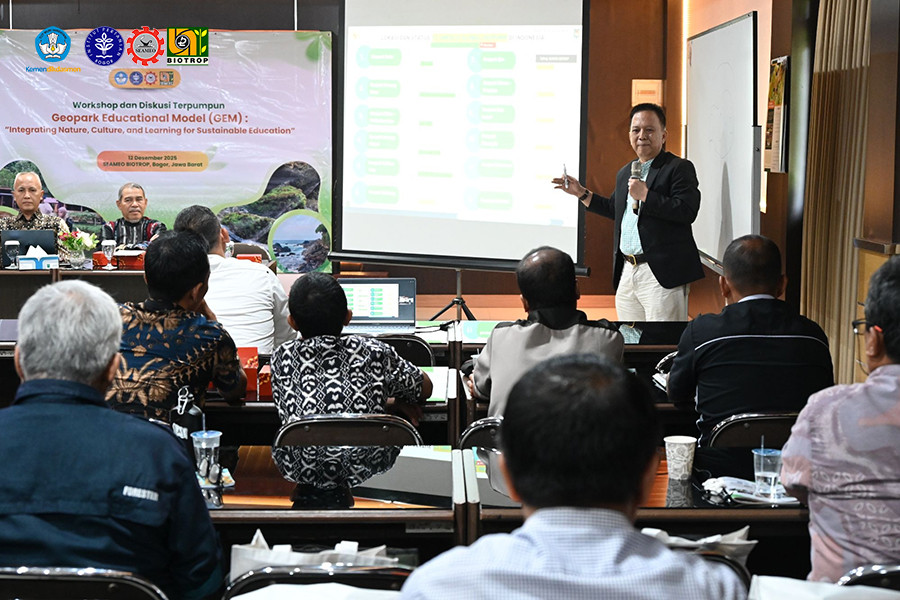
Bogor, 12 December 2025 — SEAMEO BIOTROP introduced the Geopark Educational Model (GEM), one of the flagship programs under BIOTROP Outlook 2026, focusing on Integrating Nature, Culture, and Learning for Sustainable Education. The workshop featured key speakers Dr. Doni Yusri (Deputy Director for Program, SEAMEO BIOTROP), Togu Pardede (Director of Energy, Mineral, and Mining Resources, Bappenas), Dr. Ricky Avenzora, and Dr. Burhanuddin Masyud (both from the Department of Forest Resources Conservation and Ecotourism, Faculty of Forestry and Environment, IPB University). The event invited around 50 participants representing the Ministry of Primary and Secondary Education of Indonesia, Ministry of Culture, National Development Planning Agency, Komite Nasional Indonesia UNESCO, Geopark representative, BIOTROP internal staff, university representatives, school teachers/academics, and related partners.
The activity was conducted through a hybrid workshop (online and onsite) and a Focus Group Discussion session. GEM aims to integrate geodiversity, biodiversity, and cultural values to create meaningful learning experiences. As one of SEAMEO BIOTROP’s flagship programs, the Geopark Educational Model is expected to support sustainable education by linking local wisdom, community knowledge, and ecological awareness.
In his remarks on Geoparks as future learning spaces, Dr. Doni Yusri explained that GEM is SEAMEO BIOTROP’s initiative to bring together nature, culture, and scientific knowledge, fostering contextual learning rooted in local landscapes and community life. He emphasized, “This program is part of BIOTROP’s mission to consistently prioritize biodiversity through education, and it requires support from many stakeholders.”
In his presentation on integrating Geoparks into national development planning, Togu Pardede stated that Geopark empowerment is included in BAPPENAS’s national planning and is strongly aligned with the SDGs. Geoparks contribute to multiple SDG pillars, including conservation, education, and economic development. He illustrated the benefits of Geoparks by citing Toba Geopark, which has reduced landslide risks and improved land cover, and Batur Geopark, which supports economic growth through ecotourism and geo-tourism.
During his presentation on Landscape Conservation and Geopark-Based Ecotourism, Dr. Ricky Avenzora highlighted that implementing GEM will face significant challenges related to the speed, scale, and quality of ecotourism. He also elaborated on the complex interconnections within the ecotourism system. He concluded by emphasizing, “Our mission is to turn our students into agents of information, agents of activity, and agents of change.”
In his presentation developing the GEM concept, Dr. Burhanuddin Masyud discussed the need for a future-oriented Geopark-based education strategy, where education must function as a process of humanization rather than hominization. He explained that Geopark-based learning should integrate three domains synergistically: education about, for, and in or through geoparks. He concluded by stressing the importance of optimizing SEAMEO BIOTROP’s role to implement GEM in support of sustained innovation and education.
The Focus Group Discussion (FGD) session led by Ms. Dewi Suryani centered on developing the GEM implementation framework, resulting in proposed comprehensive modules (including fundamental concepts, practical guidelines, and field activities) as well as detailed discussions on Standard Operating Procedures (SOPs) for governance and impact evaluation. Participants also recommended the importance of outreach and establishing Geopark information centres within communities. Responding to this, Dr. Doni Yusri emphasized that GEM implementation will be carried out in stages, beginning with empowering communities as agents of information before moving to broader action phases.
The workshop and FGD successfully produced an integrated GEM framework ready for implementation, marking SEAMEO BIOTROP’s strong commitment to bridging Geopark knowledge with school-based educational practice. This initiative reaffirms BIOTROP’s dedication to empowering teachers and students as ecological change agents while supporting the achievement of the Sustainable Development Goals (SDGs) through the optimal utilization of local landscapes across Southeast Asia. (Muhammad Daffa Maghfiroh)