SEAMEO BIOTROP Contributes to Regional Dialogue at University of Tsukuba Symposium
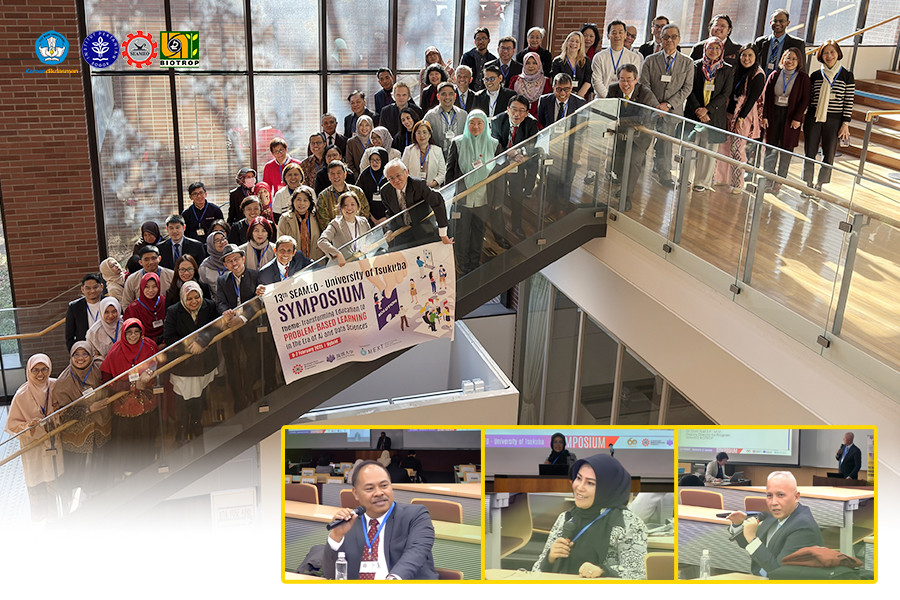
Tokyo, 7 February 2026 — The Board of Directors of SEAMEO BIOTROP actively participated in the 14th SEAMEO–University of Tsukuba Symposium held on 3–7 February 2026 at the University of Tsukuba, Tokyo, Japan. The symposium was organized by the SEAMEO Secretariat in collaboration with the University of Tsukuba (CRICED) and Japan’s Ministry of Education, Culture, Sports, Science and Technology (MEXT).
The SEAMEO BIOTROP delegation comprised Prof Edi Santosa, Director of the Centre; Dr Elis Rosdiawati, Deputy Director for Administration; and Dr Doni Yusri, Deputy Director for Programme. Their participation reflected SEAMEO BIOTROP’s commitment to advancing regional dialogue on digital transformation for equitable and sustainable education, with a strong emphasis on biodiversity, inclusive STEM, and ethical governance.
On the first day of the symposium, Prof Edi Santosa served as an expert panel speaker in a session themed “Sustainable, Safe, and Smart Digital Transformation: Designing Climate-Responsive and Ethical Systems.” In his presentation, he highlighted the importance of positioning digital transformation in education within the broader framework of environmental sustainability and biodiversity conservation. Drawing on SEAMEO BIOTROP’s applied experience, he emphasized that digital and AI-enabled learning must be guided by ethical responsibility, climate resilience, and human-centred values rather than technology alone.
During the parallel sessions on the second day, Dr Elis Rosdiawati presented in the sub-theme “Strengthening Digital Education Systems for Equity, Quality, and Resilience.” Her presentation showcased Agro-Eco-Edu-Tourism (AEET) and Smart Urban Farming as applied STEM approaches that integrate place-based and experiential learning. She also underscored the importance of teacher capacity building, institutional readiness, and inclusive practices to ensure that digital education systems reach diverse learner groups.
In a separate parallel session under the theme “Advancing Inclusive STEM and Digital Health for Sustainable Development,” Dr Doni Yusri presented a paper on AEET as an integrated policy platform linking STEM education, digital health, food security, and community wellbeing. He highlighted how food systems can serve as living laboratories for inclusive STEM learning, particularly in reaching food-insecure and underserved communities, while contributing to multiple Sustainable Development Goals.
Through active engagement as speakers and presenters, the SEAMEO BIOTROP Board of Directors contributed practice-based and policy-relevant insights to the regional dialogue. The symposium also reinforced the strategic role of SEAMEO Centres as knowledge hubs in promoting equity-first digital transformation, inclusive STEM grounded in local ecosystems, and education systems that are resilient, ethical, and sustainable.
The insights gained from the Tsukuba Symposium are expected to inform SEAMEO BIOTROP’s future programme planning, knowledge dissemination, and collaboration with other SEAMEO Centres and Japanese partners, further strengthening its contribution to sustainable development in the region.