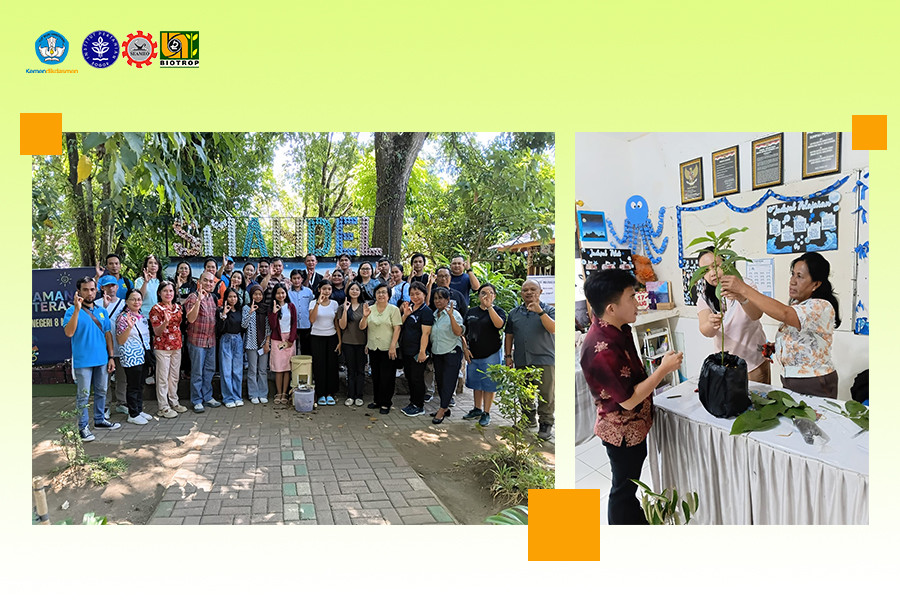
SEAMEO BIOTROP Enhances Teachers' Capacity through Smart Urban Farming Training in Manado
Manado, Indonesia, 29 June 2026 — SEAMEO BIOTROP organized the Smart Urban Farming Training for Teachers and Education Personnel: Utilizing Agricultural Technology for Sustainable Food Education at SMA Negeri 7 Manado, North Sulawesi, from 29 June to 2 July 2026. The four-day program was attended by 30 teachers and education personnel representing elementary, junior high, senior high, and special education schools (SLB) across Manado. The training was conducted as part of SEAMEO BIOTROP's commitment to strengthening educators' capacity to integrate agricultural technology and food security education into school learning.
The program was officially opened by Deputy Director for Program of SEAMEO BIOTROP, Dr. Doni Yusri. In his opening remarks, he introduced the role and mandate of SEAMEO BIOTROP as one of the SEAMEO Regional Centres dedicated to research, development, and the dissemination of knowledge in tropical biology. Dr. Doni emphasized that food security is not merely about agricultural production but also about fostering sustainable learning processes and practical implementation. According to him, Smart Urban Farming provides a relevant approach to contextual learning while strengthening public awareness of the importance of food security.
Representing the Provincial Government of North Sulawesi, the Head of the relevant Division expressed appreciation for the implementation of the training. In the address, it was emphasized that the program aims not only to enhance teachers' competencies but also to encourage the implementation of contextual learning in schools. Through the Smart Urban Farming approach, teachers are expected to adopt more practical teaching methods while fostering students' understanding of food security, creativity, innovation, and environmental awareness. The program is expected to generate positive impacts on both education and sustainable development in North Sulawesi.
The Principal of SMA Negeri 7 Manado also expressed appreciation for the program, noting that it aligns with the school's commitment as an Adiwiyata School, which has actively implemented various environmentally friendly practices. He explained that the school has developed a food waste management system by converting food waste into organic fertilizer to support campus greening initiatives. Therefore, the Smart Urban Farming training is considered highly relevant to the school's vision of promoting environmental stewardship.
Meanwhile, Training Coordinator Mr. Slamet Widodo explained that throughout the four-day program, participants would engage in a combination of conceptual learning and hands-on practice. The training topics include mushroom cultivation, fruit cultivation in pots (tabulampot), aquaponics, and the implementation of Smart Urban Farming in school environments. As part of the learning process, participants will also conduct field visits to several schools in Manado that have successfully implemented Smart Urban Farming as an educational approach.
Through this training, SEAMEO BIOTROP expects teachers and education personnel not only to acquire new knowledge and practical skills but also to implement and replicate Smart Urban Farming practices in their respective schools. Ultimately, the program is expected to strengthen environment-based education, increase awareness of food security, and foster a generation that is creative, innovative, and committed to environmental sustainability.