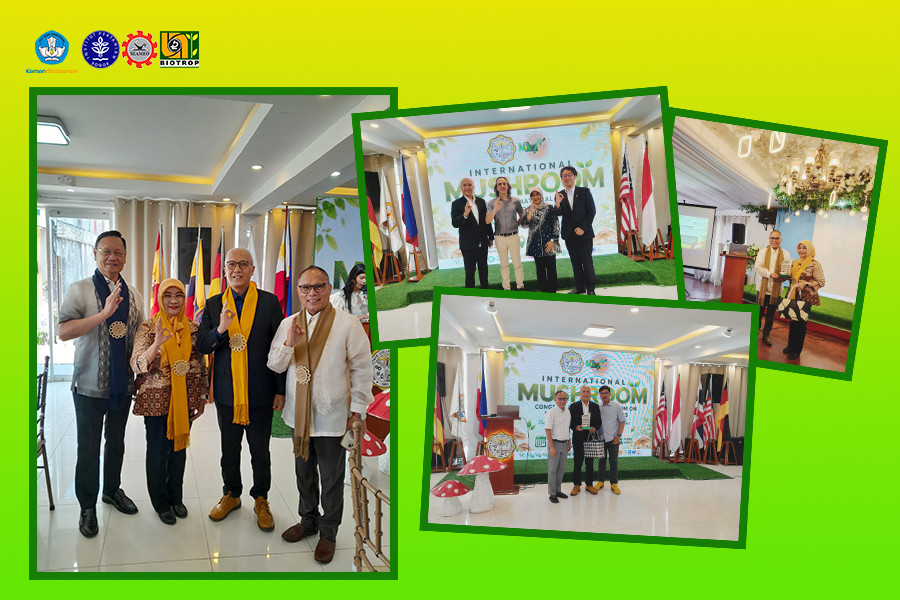
SEAMEO BIOTROP Strengthens Regional Collaboration at the 1st International Mushroom Congress in the Philippines
Baler, Aurora, Philippines, 29 May 2026 — SEAMEO BIOTROP participated in and co-organized the 1st International Mushroom Congress held on 28–29 May 2026 at AMCO Sabang, Baler, Aurora, Philippines. Hosted by Aurora State College of Technology (ASCOT) and the Philippine Association of Agriculturists–Tamarind Chapter, the congress brought together scientists, researchers, innovators, industry leaders, government representatives, and development partners from across Southeast Asia and beyond to promote collaboration, innovation, and sustainable development through mushroom research and technology.
As one of the regional centres under the Southeast Asian Ministers of Education Organization (SEAMEO), SEAMEO BIOTROP remains committed to advancing tropical biology research, innovation, capacity building, and regional cooperation. The Centre's involvement in the congress reflects its continued efforts to strengthen partnerships and facilitate knowledge exchange on emerging opportunities in sustainable agriculture, food innovation, and circular bioeconomy development.
The event featured distinguished speakers and participants from Vietnam, Japan, Indonesia, Thailand, Spain, and the Philippines, providing a valuable platform for sharing scientific advances and practical innovations in mushroom science and technology. The congress was jointly organized through the collaboration of ASCOT, SEAMEO BIOTROP, Maejo University, Central Luzon State University, Apayao State College, Kalinga State University, Pampanga State Agricultural University, Batanes State College, Bataan Peninsula State University, Nueva Ecija State University, Central Bicol State University of Agriculture, and several government agencies and local institutions in the Philippines.
The partnership between SEAMEO BIOTROP and ASCOT demonstrates a shared commitment to advancing research, education, sustainable agriculture, food innovation, and community empowerment through mushroom science and technology. Through such collaboration, Southeast Asian institutions can work together more effectively to address global challenges related to food security, climate change, sustainable livelihoods, and circular bioeconomy development.
Mushrooms possess tremendous potential not only as nutritious food sources but also as environmentally sustainable commodities capable of utilizing agricultural waste and contributing to resource-efficient production systems. The congress therefore served as an important venue for exploring innovative solutions that support both environmental sustainability and economic development.