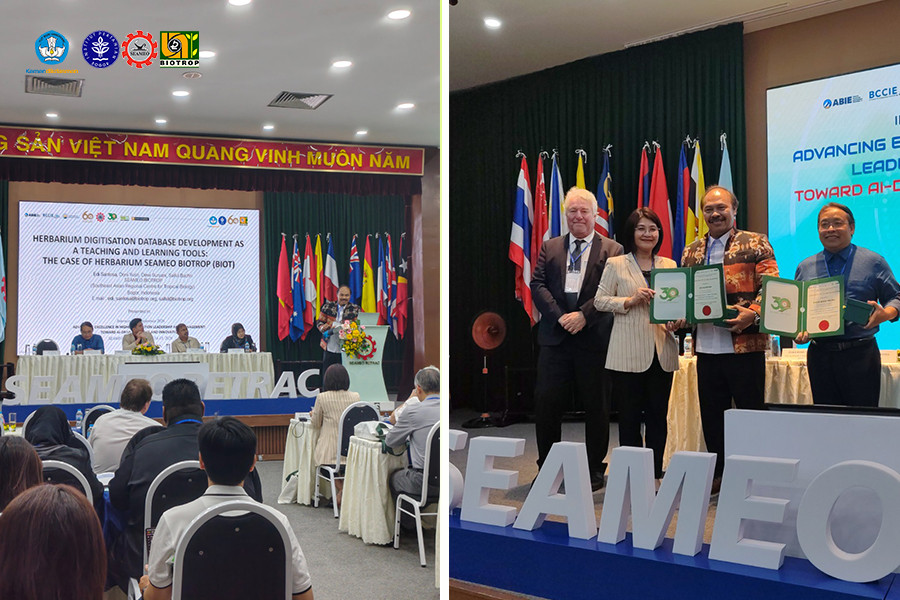
Optimizing Scientific Collections for Future Education and Research: SEAMEO BIOTROP Highlights Herbarium Digitization on the International Stage.
Ho Chi Minh City, Vietnam – How can centuries-old plant specimens find new life in an AI-driven educational landscape? SEAMEO BIOTROP addressed this question at the International Conference 2026, hosted by SEAMEO RETRAC in Ho Chi Minh City on 14–15 October 2026.
Centering on the theme “Advancing Excellence in Higher Education Leadership and Management: Toward AI-Driven Practice and Innovation,” the two-day gathering brought together academic leaders and educators from 12 countries. Across three keynote speeches and eight plenary sessions, discussions focused on reshaping higher education leadership, updating curricula, and thoughtfully weaving emerging technologies into everyday teaching and learning.
During the sessions, SEAMEO BIOTROP Director Prof. Edi Santosa shared the Centre’s latest work in a presentation titled “Herbarium Digitisation Database Development as a Teaching and Learning Tools: The Case of Herbarium SEAMEO BIOTROP (BIOT).”. He highlighted that herbarium sheets are much more than physical archives tucked away in storage. When digitized, these scientific collections turn into active, accessible learning tools. By bringing Herbarium BIOT online, students and researchers across Southeast Asia and beyond can examine tropical flora specimens directly from their laptops—enriching biology coursework, supporting virtual lab work, and opening doors to cross-border research collaborations.
The initiative directly reflects the wider spirit of the conference: adopting innovative technologies not for their own sake, but to serve meaningful, human-centered education grounded in critical thinking and international partnership.
By opening up its biological collections to the digital world, SEAMEO BIOTROP continues to bridge traditional field science and modern digital learning, making tropical biodiversity conservation more relevant and accessible to the next generation of learners.