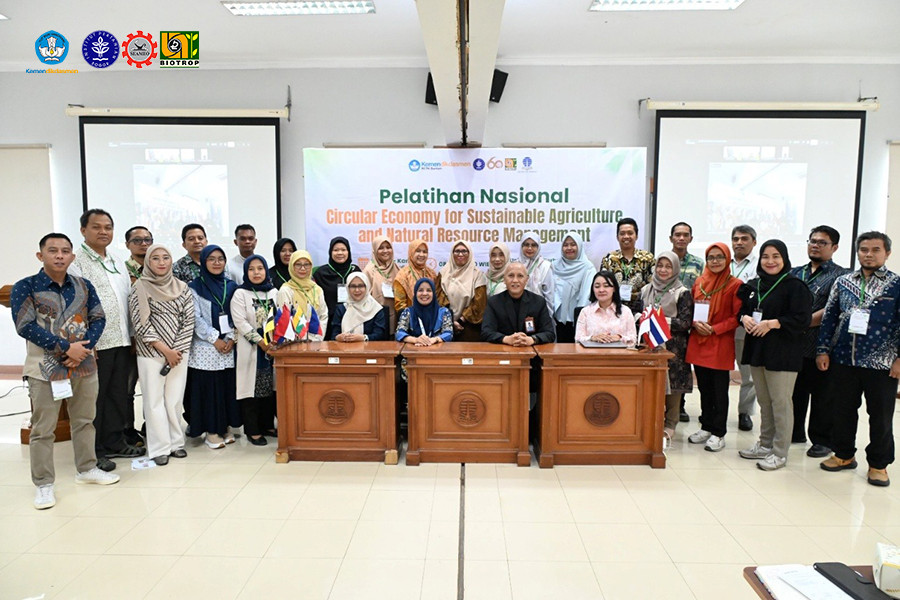
SEAMEO BIOTROP Strengthens Teachers' Capacity in Implementing Circular Economy for Sustainable Agriculture
Banten, Indonesia, 7 July 2026 — SEAMEO BIOTROP organized the National Training on Circular Economy: Circular Economy for Sustainable Agriculture and Natural Resource Management at Universitas Terbuka Serang, Banten, from 7–9 July 2026. The three-day training brought together 30 senior high school teachers from Banten Province and surrounding areas, with resource persons and instructors from SEAMEO BIOTROP and IPB University. The program was organized in response to the growing volume of organic waste while reinforcing the strategic role of teachers as agents of change in promoting the implementation of Circular Economy principles in schools and communities.
The program was officially opened by Deputy Director for Program of SEAMEO BIOTROP, Dr. Doni Yusri. In his opening remarks, he expressed his appreciation to the participating teachers and emphasized the importance of creating tangible impacts through the implementation of the knowledge gained during the training in their respective schools. He explained that waste management is not merely about reducing the amount of waste but also about transforming it into value-added products that generate economic, social, and environmental benefits. At the conclusion of his remarks, Dr. Doni Yusri officially inaugurated the National Training on Circular Economy.
Representing the Head of the Center for Teachers and Education Personnel of Banten Province, Ms. Apriana Anggraini highlighted that Indonesia continues to face significant challenges in waste management, contributing to various environmental issues, including climate change and the increasing risk of natural disasters. Therefore, she emphasized that the implementation of Circular Economy principles offers a practical solution for maximizing the utilization of waste while supporting sustainable development.
Meanwhile, representing Universitas Terbuka Serang, Ms. Is Eka Herawati expressed her appreciation for the collaboration with SEAMEO BIOTROP in organizing the training. She hoped that the knowledge and skills acquired during the program would serve as valuable resources for teachers to implement in their respective schools, ultimately benefiting students through more contextual and sustainability-oriented learning.
In the activity report, Ms. Risa Rosita, represented by Ms. Dewi Suryani, explained that the national training was designed to strengthen teachers' capacity as agents of change in implementing Circular Economy principles within educational settings. According to her, the application of Circular Economy contributes not only to waste reduction but also to sustainable agricultural development and integrated natural resource management. She expressed her hope that participants would implement the knowledge gained by developing action plans and integrating Circular Economy principles into classroom learning in their respective schools.
Throughout the three-day program, participants engaged in a combination of conceptual learning and hands-on practice. The training covered topics including the production of bioenzymes from fruit waste and aromatic plant incense (bukhur), biomass utilization for mushroom cultivation, and organic waste management using Black Soldier Fly (BSF) larvae as practical applications of Circular Economy principles to support sustainable agriculture and natural resource management.
Through the National Training on Circular Economy, SEAMEO BIOTROP expects participants to strengthen their capacity to apply Circular Economy principles, particularly in organic waste management, biomass utilization, and sustainable agriculture. Furthermore, participants are expected to develop implementation action plans for their respective schools, enabling Circular Economy-based learning to be applied sustainably while generating tangible benefits for both the environment and society.