Advancing Climate Resilience: SEAMEO BIOTROP Trains Philippine Educators to Turn Marginal Lands into Productive Learning Hubs
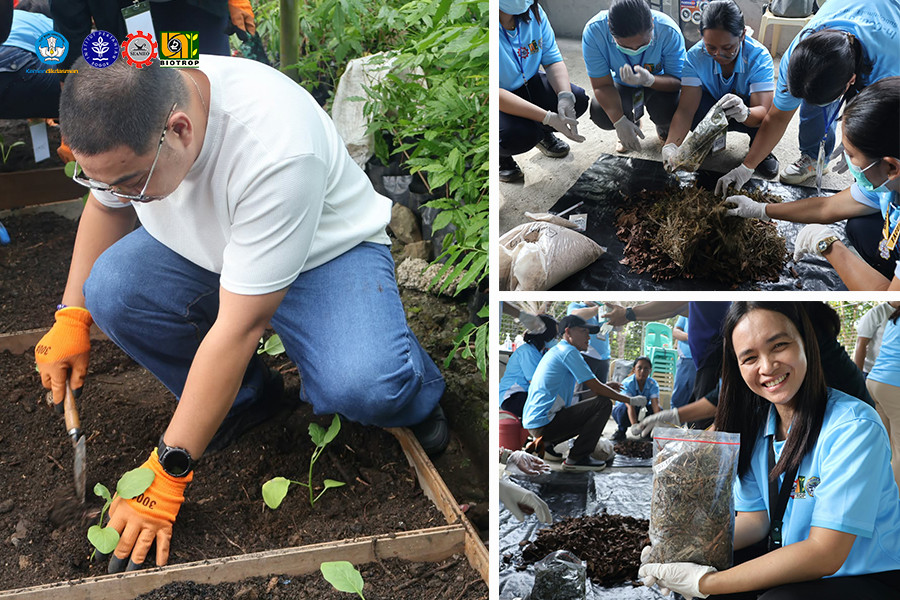
BALER, AURORA, PHILIPPINES — SEAMEO BIOTROP, in collaboration with Aurora State College of Technology (ASCOT), held the In-Country Training on Suboptimal Land Management and Utilization for Sustainable Education and Production on 28–30 October 2026 at ASCOT in Baler, Aurora. The three-day training brought together 30 Filipino educators to explore practical biological techniques and agroengineering approaches for making better use of marginal and nutrient-poor land. Through hands-on learning and practical applications, participants gained knowledge and skills to transform underutilized land into productive spaces that support school-based learning and local food production.
Suboptimal lands across Southeast Asia—often hampered by acidic soils, low fertility, or climate risks—present critical agricultural hurdles that require grounded scientific solutions. SEAMEO BIOTROP framed these fragile landscapes as strategic opportunities for educational innovation, localized food security, and climate adaptation. By targeting educators, the Centre aims to bridge cutting-edge research with grassroots practice, empowering teachers to integrate soil rehabilitation and sustainable agriculture directly into school curricula and community outreach.
ASCOT President Renato G. Reyes officially opened the program, underscoring the vital impact of cross-border institutional partnerships in advancing educational and agricultural capacity. The ceremony welcomed Commissioner Michelle Ong of the Commission on Higher Education (CHED), ASCOT Vice President Mayreen V. Amazona, SEAMEO BIOTROP Governing Board Member for the Philippines and Our Lady of Perpetual Succor College (OLOPSC) Director Marita Canapi, and OLOPSC College Dean Daniel Ambrocio, alongside the initial signing of partnership agreements between BIOTROP, ASCOT, and OLOPSC. In his opening remarks, Dr. Doni Yusri, Deputy Director for Programme of SEAMEO BIOTROP, emphasized that suboptimal lands should be viewed as opportunities to pioneer sustainable farming and environmental resilience, noting that proper scientific and technological interventions in these areas directly bolster regional food security and rural livelihoods.
The curriculum combined theoretical instruction, laboratory exercises, and field practice led by SEAMEO BIOTROP experts alongside Philippine resource persons. Dr. Doni Yusri delivered sessions on the characteristics of suboptimal soils and disaster mitigation, while Risa Rosita, Manager of BIOTROP’s Science Innovation Technology Department, guided participants through the production of BIOPOS (BIOTROP Compost) using local materials like spent mushroom substrate, rice straw, and plant waste. Additional sessions covered mushroom biotechnology with Prof Renato G. Reyes, garlic-based organic pesticides with Asst. Prof. Jomer Mangawang, dryland crop cultivation with Assoc. Prof Jonah Zante, and water quality analysis using digital pH and TDS meters led by Alya Shafira, of BIOTROP and Dr. Chito Sace of ASCOT.
Supporting United Nations Sustainable Development Goals (SDGs) notably SDG 2 (Zero Hunger), SDG 4 (Quality Education), SDG 13 (Climate Action), SDG 15 (Life on Land), and SDG 17 (Partnerships for the Goals), the training culminated in institutional action plans for participants to replicate demonstration plots and eco-projects in their home institutions. The initiative reaffirmed SEAMEO BIOTROP’s institutional mission to translate applied tropical biology into enduring regional capacity, environmental stewardship, and community empowerment.