SEAMEO BIOTROP Organizes Circular Economy Training to Support Sustainable Agriculture
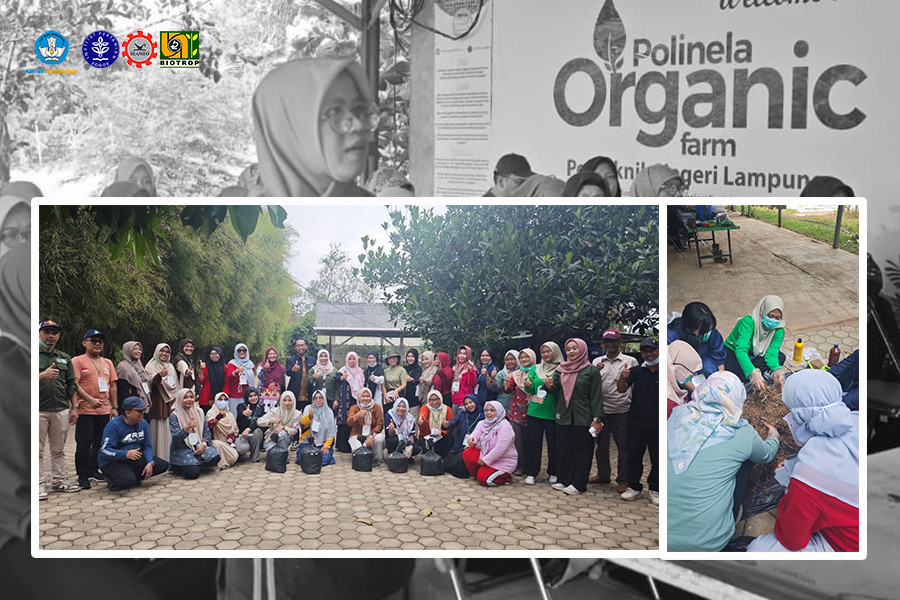
Lampung, Indonesia, 4 August 2026 — SEAMEO BIOTROP organized the National & Regional Training Circular Economy Seminar at Lampung State Polytechnic (Polinela), Lampung, from 4–7 August 2026. The event consisted of a National Training attended by 30 senior high school teachers from across Lampung Province and a Regional Seminar conducted in a hybrid format (onsite and online), involving approximately 147 participants, including educators, lecturers, researchers, students, government representatives, private sector representatives, non-governmental organizations, and practitioners from Indonesia, the Philippines, Malaysia, and Vietnam.
The training was organized in response to the increasing volume of organic waste generated by the agricultural and household sectors, which poses significant challenges to environmental management. Through this program, participants are expected to apply Circular Economy principles by transforming organic waste and biomass into value-added products and implementing these practices to support sustainable agriculture, natural resource management, and environmental sustainability in educational institutions, workplaces, and local communities.
The Director of Lampung State Polytechnic (Polinela), Dwi Puji Hartono, expressed his appreciation for the trust placed in Polinela as the host institution. He reaffirmed the institution's commitment to supporting innovation, collaboration, and the advancement of vocational education in sustainable agriculture. According to him, the training is expected to strengthen environmental awareness while promoting Circular Economy practices that contribute to regional development.
The event was officially opened by Doni Yusri, Deputy Director for Program of SEAMEO BIOTROP. In his opening remarks, he emphasized that the increasing volume of organic waste requires more sustainable approaches through the implementation of Circular Economy principles. Therefore, the program is expected not only to enhance participants' competencies but also to serve as a platform for strengthening collaboration, fostering innovation, and advancing sustainable development in Indonesia and across Southeast Asia.
Doni also explained that the program forms part of a community engagement initiative under the "Dosen Pulang Kampung" (Lecturers Returning to Their Hometowns) Program, reflecting the synergy among higher education institutions, research organizations, and local governments in transferring scientific knowledge and technology to communities. Through this collaboration, innovations and Circular Economy practices are expected to be implemented more widely to support sustainable agriculture and natural resource management at the local level.
Thomas Amriko, Head of the Lampung Provincial Education Office, stated that improving teachers' competencies through this program is expected to strengthen students' critical thinking skills and learning motivation. He also reaffirmed the commitment of the Provincial Government of Lampung to encouraging schools to integrate environmental issues, climate change, and Circular Economy concepts into teaching and learning activities as part of its efforts to support sustainable regional development.
In her report, Programme Coordinator Ms. Risa Rosita explained that the National Training was designed to strengthen teachers' capacities through a combination of lectures, demonstrations, and hands-on practical sessions focusing on the utilization of organic waste and biomass. In addition, the Regional Seminar served as a platform for educators, academics, researchers, practitioners, and other stakeholders to exchange knowledge and experiences regarding the implementation of Circular Economy principles in sustainable agriculture and natural resource management.
Throughout the training, participants explored a range of topics, including Bioenzyme Production from Fruit Waste and Aromatic Plant Waste, Utilization of Biomass for Mushroom Cultivation, Organic Waste Management Using Black Soldier Fly (BSF), and Natural Resource Management Based on Circular Economy. Through these learning sessions, participants are expected to strengthen their technical competencies in organic waste management and biomass utilization while developing action plans for implementing Circular Economy practices in their schools and respective institutions.
The program featured resource persons and instructors from SEAMEO BIOTROP, IPB University, Lampung State Polytechnic (Polinela), SEAMEO QITEP in Science (SEAQIS), as well as practitioners with expertise in Circular Economy, sustainable agriculture, organic waste management, biotechnology, and natural resource management.
The event was organized with the support of the Ministry of Primary and Secondary Education of the Republic of Indonesia through collaboration among SEAMEO BIOTROP, IPB University, Lampung State Polytechnic (Polinela), the Lampung Provincial Education and Culture Office, and SEAMEO QITEP in Science (SEAQIS). Through the implementation of the National & Regional Training Circular Economy Seminar, SEAMEO BIOTROP hopes to strengthen collaboration in promoting the adoption of Circular Economy principles as an integral part of sustainable agriculture, natural resource management, and environmental sustainability in Indonesia and throughout Southeast Asia.