SEAMEO BIOTROP Organizes National Training and Regional Seminar on Circular Economy to Advance Sustainable Education and Environmental Management
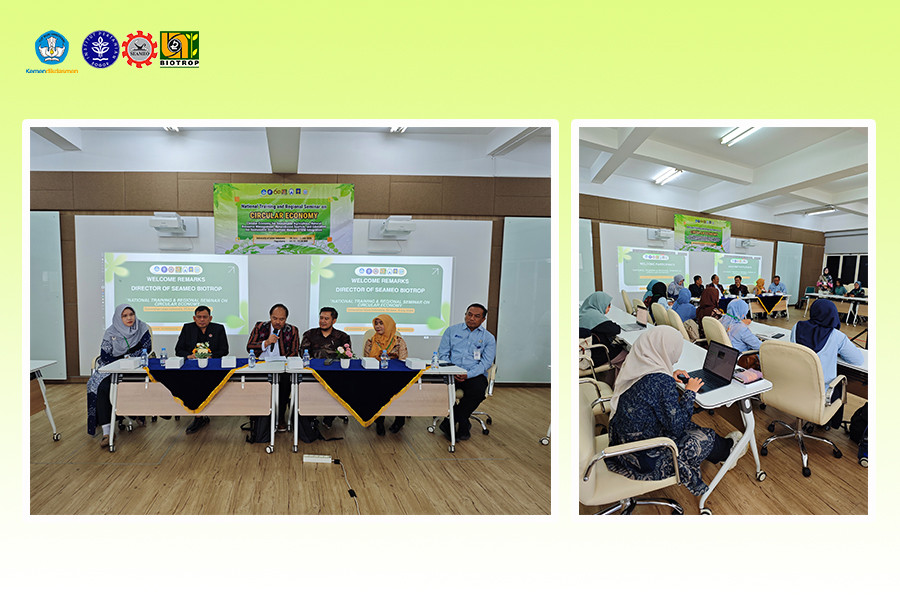
Yogyakarta, Indonesia, 30 June 2026 — SEAMEO BIOTROP organized the National Training and Regional Seminar on Circular Economy in Yogyakarta to strengthen the capacity of educators and stakeholders while enhancing their understanding of circular economy concepts, policies, innovations, and best practices in support of sustainable agriculture, organic waste management, and the utilization of biological resources. The four-day event comprised a Regional Seminar, conducted in a hybrid format with approximately 70 participants from various institutions across Southeast Asia, and a National Training, attended in person by 30 senior high school teachers from the Special Region of Yogyakarta and surrounding areas. Resource persons and instructors were drawn from SEAMEO BIOTROP, Universitas Islam Indonesia (UII), SEAQIM, and IPB University.
The event was officially opened by Director of SEAMEO BIOTROP, Dr. Edi Santosa. In his opening remarks, he emphasized that the concept of the circular economy extends beyond economic aspects and serves as a strategic approach to promoting sustainable environmental management. He explained that the adoption of innovative waste and biomass management practices within educational institutions is expected to strengthen participants' knowledge and practical skills for implementation in schools and local communities. Through this initiative, SEAMEO BIOTROP reaffirmed its commitment to supporting community empowerment and sustainable development in Indonesia and across Southeast Asia.
Representing Universitas Islam Indonesia (UII), Prof. Ilya Fajar Maharika expressed his appreciation for the collaboration, noting that the program aligns with the university's vision of advancing sustainable education. He highlighted the importance of integrating biology and biotechnology to address future challenges and reminded participants that plants are essential partners in sustaining human life. Likewise, Head of the Center for Climate Change and Disaster Studies, Dr. Dewi Wulandari, emphasized that the circular economy is not merely an economic concept but also a practical solution for reducing waste and promoting environmental sustainability.
Deputy Director for Program of the SEAMEO Regional Centre for QITEP in Mathematics (SEAQIM), Mr. Jatnika Hermawan, stated that the collaboration between SEAMEO BIOTROP and SEAQIM is expected to generate innovations that contribute to addressing waste management challenges and advancing sustainable development across Southeast Asia. Meanwhile, a representative of the Education, Youth, and Sports Office of the Special Region of Yogyakarta highlighted that the event reflects the region's development philosophy, which promotes harmony between people, the environment, and the principles of sustainability.
In her report, Training Coordinator, Ms. Risa Rosita, explained that participants would take part in a four-day series of seminars and training sessions combining conceptual learning with hands-on practice. The training covered bioenzyme production from fruit waste and incense from aromatic plants, fermentation and organic fertilizer production, biomass utilization for mushroom cultivation, the use of Black Soldier Fly larvae for organic waste bioconversion, the application of circular economy principles in sustainable ecotourism destination management, and the implementation of Project-Based Learning (PjBL) to support circular economy-based education.
Through the National Training and Regional Seminar on Circular Economy, SEAMEO BIOTROP expects participants to apply innovative waste and biomass management practices within their respective institutions and communities. The program is expected to strengthen the implementation of the green economy, improve resource-use efficiency, support environmental conservation, and contribute to the development of more sustainable education, agriculture, and environmental management systems in Indonesia and throughout Southeast Asia.