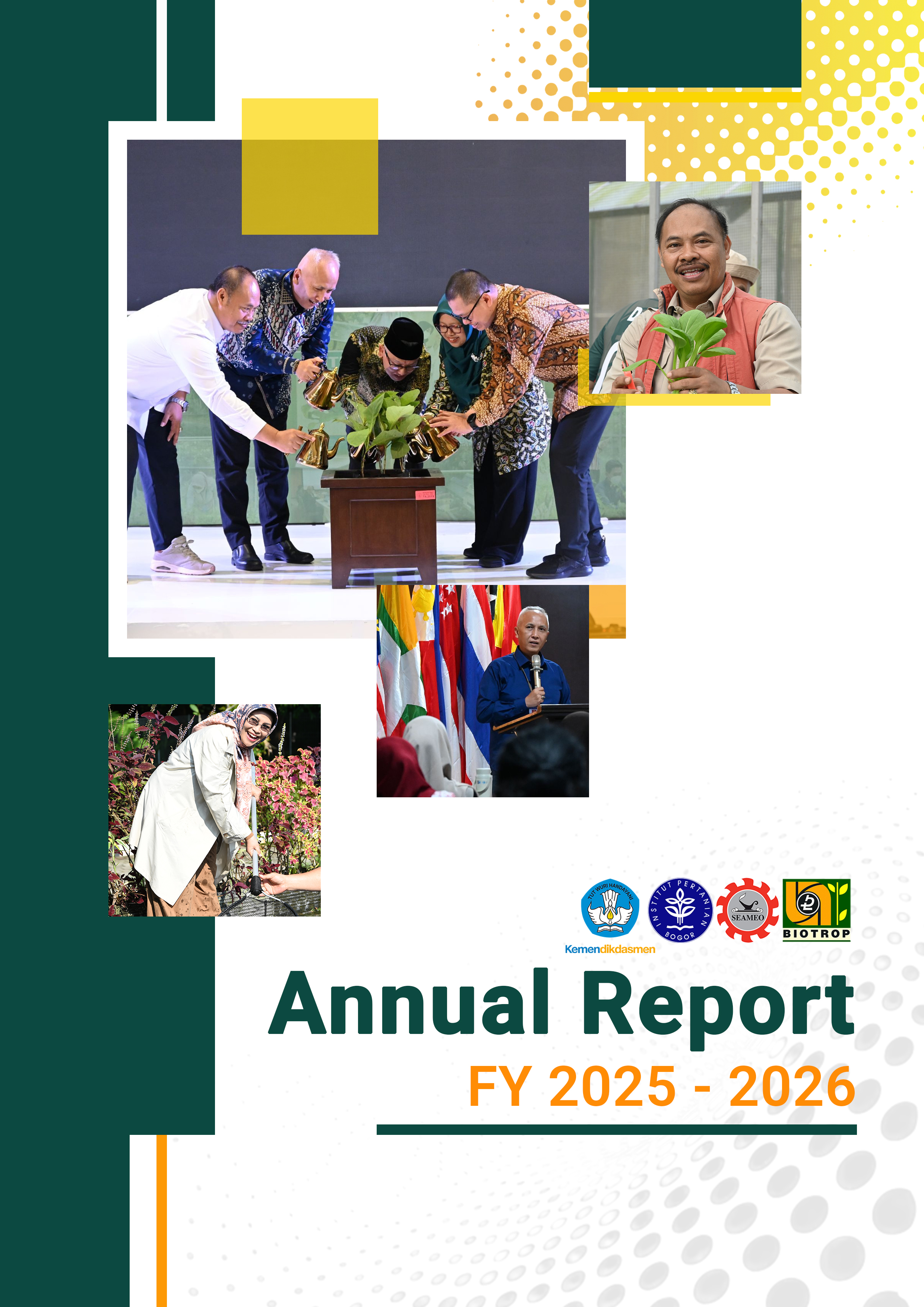
SEAMEO BIOTROP Annual Report FY 2025 - 2026
KMD, 2026Downloaded 0 times, Read 18 times
Description
Fiscal Year (FY) 2025/2026 was another productive year for SEAMEO BIOTROP as the Centre continued to strengthen its role as the SEAMEO Regional Centre for Tropical Biology. Guided by the 11th Five-Year Development Plan (2021–2026), the SEAMEO Strategic Plan 2021–2030, the SEAMEO Seven Priority Areas, and the United Nations Sustainable Development Goals (SDGs), the Centre focused on advancing research, developing human capacity, fostering regional collaboration, and translating scientific knowledge into practical applications for Southeast Asia.
Throughout the year, SEAMEO BIOTROP implemented programmes spanning tropical biodiversity, biotechnology, sustainable agriculture, environmental education, ecosystem management, scientific publication, and institutional networking. These activities not only generated new scientific knowledge but also supported efforts to address regional priorities such as biodiversity conservation, food security, climate resilience, and sustainable natural resource management.
FY 2025/2026 Highlights
Research remained at the core of the Centre’s activities. During the reporting period, SEAMEO BIOTROP completed 16 research projects covering tropical biodiversity, biotechnology, sustainable agriculture, ecosystem management, and environmental conservation. The findings from these projects contributed to scientific advancement while supporting evidence-based approaches to environmental and agricultural challenges across the region.
Capacity-building programmes also continued to grow. A total of 41 training events, including 8 international and regional programmes, were conducted for 1,683 participants from Indonesia and other Southeast Asian countries. These activities strengthened technical knowledge and encouraged collaboration among researchers, educators, government officials, and practitioners.
The Centre further expanded its network by establishing 15 new partnerships and Memoranda of Agreement (MoA) with universities, research institutions, government agencies, and international organizations. Beyond formal cooperation, these partnerships created opportunities for joint research, professional exchanges, and collaborative capacity-building initiatives.
Scientific publication remained one of SEAMEO BIOTROP’s defining strengths. During FY2025/2026, 48 peer-reviewed articles were published through BIOTROPIA and other scholarly outlets, involving 221 contributing authors from Indonesia and abroad. These publications strengthened the Centre’s international scientific presence while promoting knowledge exchange on tropical biology and related fields.
The Centre also placed strong emphasis on communicating science beyond academic audiences. Throughout the year, SEAMEO BIOTROP produced 47 media publications, 11 podcast episodes, 9 multimedia and educational videos, and 764 social media posts, bringing research findings and environmental issues closer to the public through a variety of digital platforms.
SEAMEO BIOTROP continued to serve as a regional learning hub by welcoming 1,700 visitors, 28 visiting institutions, 92 internship students, and 4 research interns. These activities provided valuable opportunities for experiential learning, research collaboration, and professional development.
Strategic Achievements
Several flagship initiatives continued to shape the Centre’s programmes during the year, including Agro-Eco-Edu-Tourism (AEET), the School of Biodiversity, Suboptimal Land Management, Circular Economy, the Geopark Educational Model, and BIOTROP Artificial Intelligence. Together, these initiatives reflect the Centre’s commitment to integrating research, education, innovation, and community engagement in responding to evolving regional needs.
Research activities generated new knowledge in biodiversity conservation, sustainable agriculture, biotechnology, ecosystem restoration, and environmental management. Equally important, many of these initiatives were implemented in close collaboration with universities, government agencies, research organizations, and development partners across Southeast Asia, reinforcing SEAMEO BIOTROP’s role as a regional platform for scientific cooperation.
Among these initiatives, Agro-Eco-Edu-Tourism (AEET) reached an important milestone in 2025. Building on its development since 2022, AEET expanded beyond Indonesia through collaborations with partners in the Philippines and Brunei Darussalam, while preparatory work began for its implementation in Vietnam. The programme also enhanced its living laboratories—including hydroponic and aquaponic systems, the Aquatic Garden, Stingless Bee Garden, and sensory and therapeutic gardens—providing hands-on learning opportunities in biodiversity conservation, sustainable agriculture, and environmental education. These achievements reflect AEET’s growing role as a regional model for biodiversity-based Education for Sustainable Development (ESD).
Knowledge dissemination also continued to evolve. Alongside its flagship journal BIOTROPIA, the Centre expanded public access to scientific information through Biodivers Magazine, BIOCourier Bulletin, policy briefs, podcasts, educational videos, and digital media. Together, these platforms helped bridge scientific research with policymakers, educators, practitioners, and the wider community.
Five-Year Institutional Performance
The achievements of FY2025/2026 represent the culmination of consistent progress made throughout the current five-year planning period.
Between FY2021/2022 and FY2025/2026, SEAMEO BIOTROP completed 115 research projects and organized 157 training events, including 42 international and regional programmes, reaching 24,556 participants. During the same period, the Centre established 95 institutional partnerships, published 198 scientific articles involving 854 authors, and produced 235 media publications, 58 podcast episodes, and 78 educational videos.
Public engagement also expanded substantially over the five-year period. The Centre recorded 1,776 social media posts, welcomed 224 visiting institutions and 10,773 visitors, and provided learning opportunities for 1,161 internship students. These achievements demonstrate the Centre’s continued growth as a regional centre for research, education, and knowledge exchange in tropical biology.
SEAMEO BIOTROP’s digital platforms likewise continued to grow in reach and engagement. By the end of FY2025/2026, the Centre had approximately 19,800 Instagram followers, 4,700 Facebook followers, and 8,320 YouTube subscribers. Supporting these activities, the library maintained a collection of approximately 130,000 scientific resources, serving researchers, students, and other stakeholders throughout the region.
Looking Forward
As SEAMEO BIOTROP enters a new planning period, the Centre will continue building on the momentum established over the past five years. Future efforts will place greater emphasis on interdisciplinary research, high-quality scientific publication, digital innovation, capacity development, and stronger regional partnerships to address increasingly complex environmental and societal challenges.
Looking ahead, the Centre aims to further strengthen its contribution to biodiversity conservation, sustainable agriculture, climate resilience, and evidence-informed policymaking across Southeast Asia. By working closely with SEAMEO Member Countries and a broad network of partners, SEAMEO BIOTROP will continue to promote scientific excellence while ensuring that research outcomes create meaningful benefits for communities, institutions, and the region as a whole.